
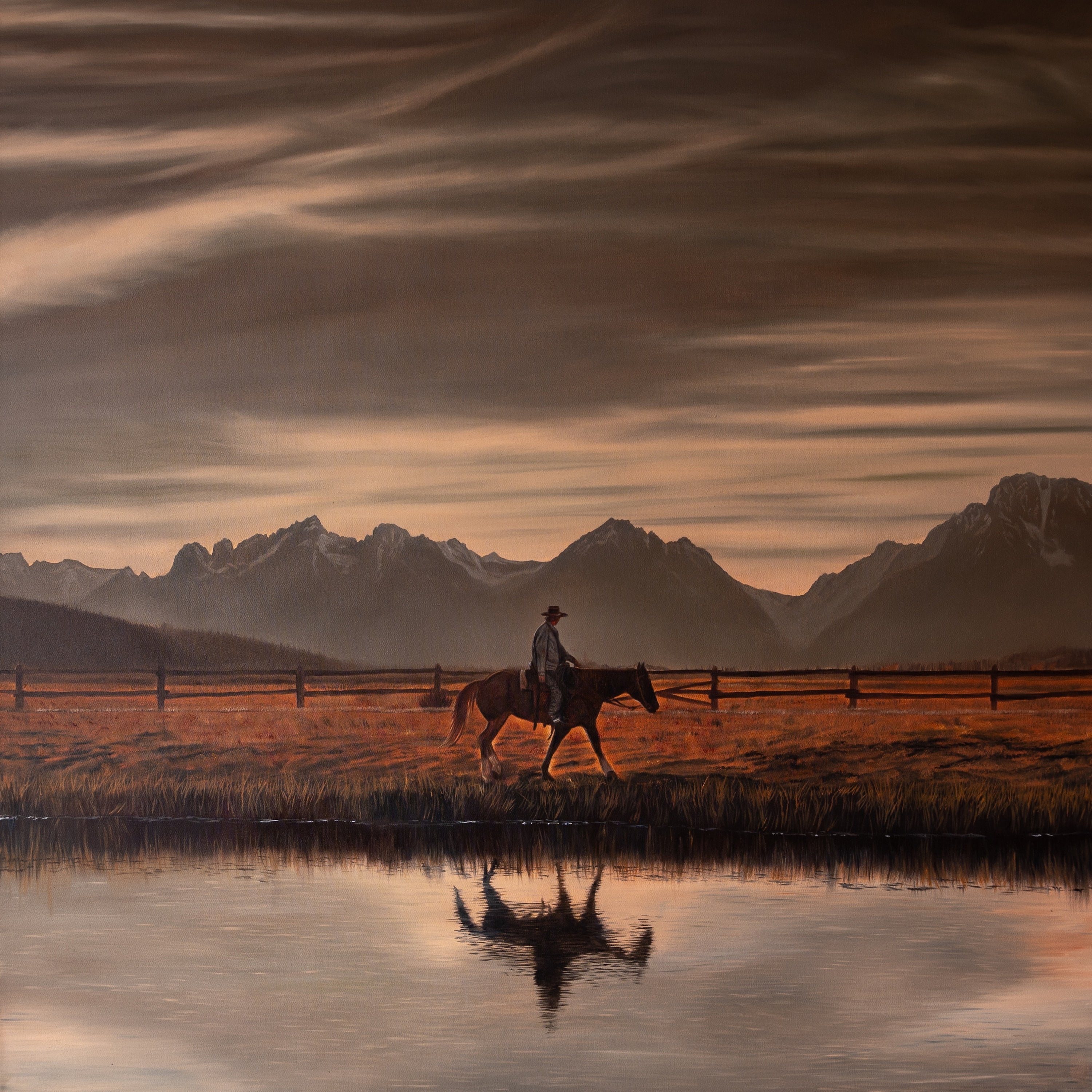
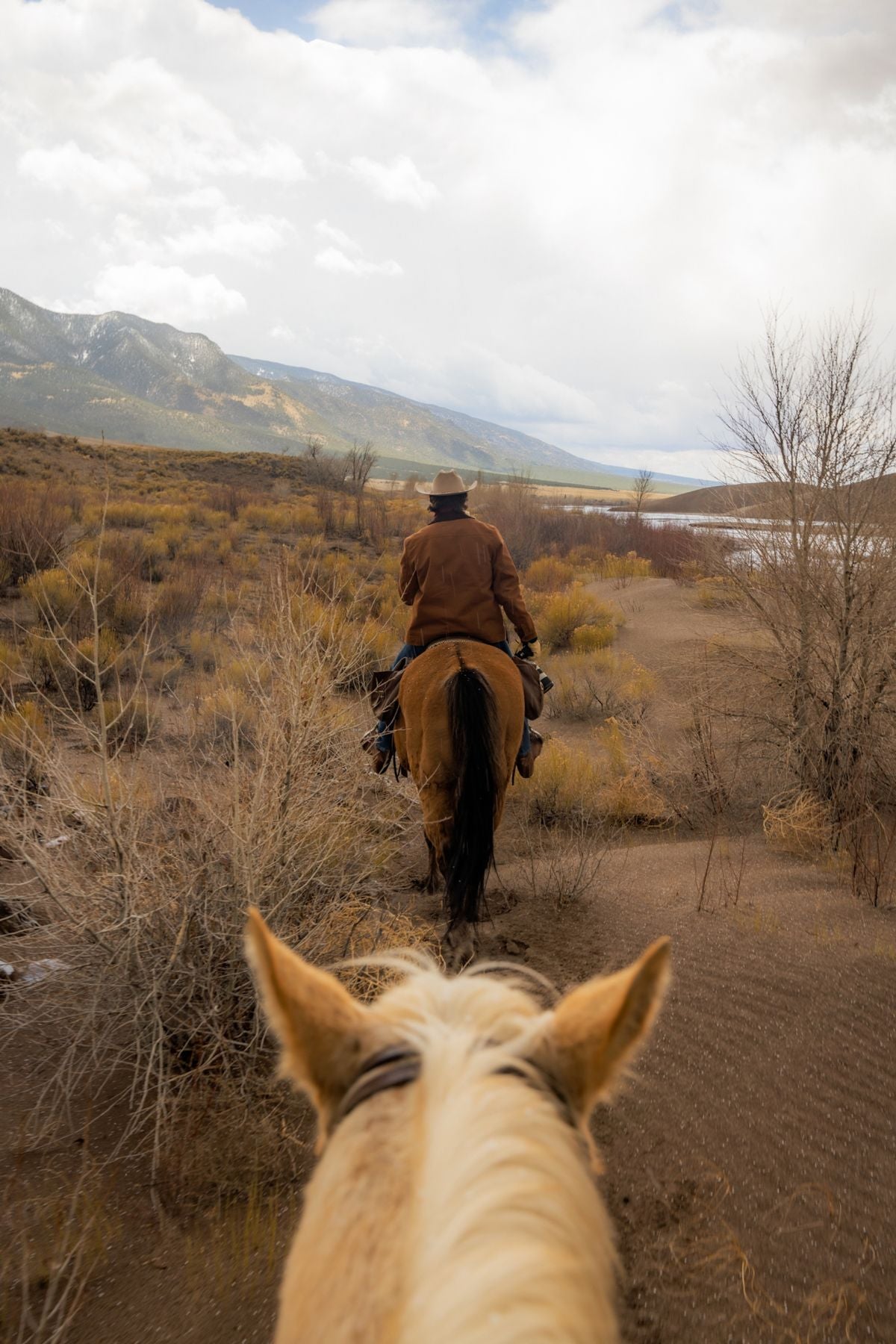
Throughout my work, you’ll notice a distinct visual frame on the canvas where the subject either enters or exits the scene. I call these frames “Western Windows”.
“Western Windows” serve simultaneously as literal framing devices and metaphoric thresholds. They are more than physical frames; they are metaphors for how we see, question, and experience the world and, in particular, the American West.
At first, these Western windows began simply as a framing device. The idea itself isn’t new, artists before me, and many today, have used negative space to shape their compositions. What drew me in was how that empty space could feel both complete and incomplete at the same time. It invites the viewer to engage: to fill it with memory, imagination, or to leave it as it is. It offered a way to differentiate my work, a fresh perspective on a traditional subject and to create a visual language that set my pieces apart. But what started as a formal element soon evolved into something more: a symbol of my personal connection to the subject and an ongoing dialogue within myself.
These windows have grown in meaning throughout my artistic journey. They mirror my own experience with the West: a longing for belonging, the tension between inclusion and distance, and the space between myself and God.
Born and raised in Fort Worth, Texas, I was always within arm’s reach of this way of life. But proximity does not equal belonging. I’ve always felt like an outsider looking in. Someone with deep respect and curiosity for the Western tradition, yet never fully part of it. My work is shaped by that distance: a window into a culture rich in values and ethos that have defined this region since the 16th century. Through my lens, I explore the myth and reality of the modern cowboy, the shifting identity of the American West, and the quiet spaces for reflection it continues to offer.
On a deeper level, these windows reflect how I have come to see not just certain moments and memories, but life itself. Throughout my journey, I’ve found acceptance in different circles, yet never felt fully at ease, never comfortable being boxed in or defined by a single role. The window, or box, represents that rigidity we as humans often push against. The figures entering or leaving the frame are, in many ways, reflections of myself: caught between the longing for acceptance and the pull toward rebellion, the desire to be understood and the need to remain free.
Later on, I came to see that the American cowboy symbolized the masculine presence I had searched for as a boy and, in time, the role I was striving to fill as a man. His quiet resilience, moral conviction, and strength embodied both what I longed for and what I hoped to become.
The cowboy archetype, long tied to stoic, self-sufficient masculinity, resonates deeply in this context. Even as ideas about manhood continue to evolve, the cowboy endures as a symbol of integrity, responsibility, and emotional strength virtues that remain vital, even as roles and expectations shift.
On the most personal level, these windows symbolize the human condition our separation from God. The figures in my work, whether they are arriving at the threshold or departing from it, whether they pause to gaze into the distance or step into the void, reflect that tension we all experience. They stand at the edge of connection, caught between a longing to draw nearer and the temptation to remain apart. Some seem on the verge of crossing into something greater, while others turn away or linger in uncertainty, mirroring the choices we face in our relationship with God. The window becomes not just a visual frame, but a spiritual one: a space where we wrestle with the decision to bridge the divide between ourselves and God, or to stay behind the barrier, looking out at what could be but never stepping through. And ultimately, whether we draw near or turn away, a decision is made, either to accept that relationship or to ignore it.